Taiwanese 16-tile mahjong
The rules of Taiwanese mahjong, on one page
Each section opens with the short version, then the detail. Where tables differ, the page says so; the sources have a page of their own. The app plays these rules, and the calculator can switch the variants.
Section 1
How a hand goes
In one line
Everyone holds 16 tiles; the dealer takes 17 and discards first. Draw one, discard one. You may chow from the player before you, pung from anyone, and kong from anyone but that player. Five sets and a pair (17 tiles) wins. Each payer pays the base plus the tai times the unit.
A winning hand: three chows, a pung, a wind pung and a pair. Seventeen tiles.
Section 2
The tiles: 144
108 suited tiles (Characters, Dots and Bamboo, 1 to 9, four of each), 28 honours (four winds and three dragons, four of each) and 8 flowers (four seasons and four plants, one of each).
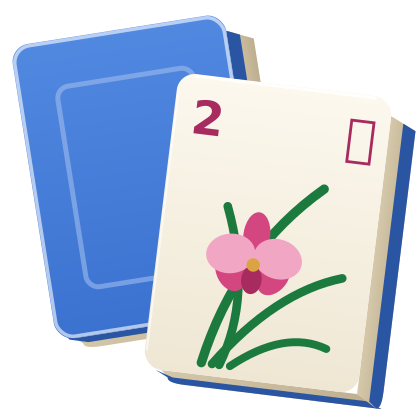
Sources split: Gamesofa, MJOnline and Wikibooks number the mum 3 and the bamboo 4; Star31, Shifu and several published tables swap them. Every flower in this app carries its number, so nobody has to remember.
It carries a bird, and players call it “the little bird”.
Section 3
Seats, seat winds, the dealer
Only in Taiwan
Seat winds follow the opened wall, not the dealer. The dealer rolls three dice and counts counterclockwise from themselves; the player reached opens the wall and is East for this hand (seat wind East, flower 1). The next player is South, then West, then North.
Each player draws one of the four wind tiles and sits accordingly, counterclockwise. Seats stay fixed for a full game of four rounds.
East, South, West, North: four rounds make a full game. In the East round, an East pung scores for anyone.
The player in the East chair rolls once to pick the first dealer; in that hand the dealer is also East. From then on the dice set East each hand.
Takes one more tile (17) and discards first. Keeps the deal after a win or a drawn hand; the deal passes only when another player wins.
Section 4
Building the wall and the deal
Each player builds a wall of 18 stacks (36 tiles). From the opened wall, counted off by the dice, players take four tiles at a time until each has 16; the dealer then takes one more. The last 16 tiles of the wall are never drawn.
Section 5
Flower replacement
The dealer lays out any flowers and draws the same number of replacements from the tail of the wall; then each player in turn. A flower drawn as a replacement waits for the next pass.
A drawn flower goes face up at once and you replace it from the tail; this can chain. Winning on the replacement scores Win on a replacement (1).
No replacement and no discard: the hand is drawn.
Section 6
Play: draw, discard, chow, pung
Play runs counterclockwise. The dealer discards first; everyone else draws one and discards one, unless they win. Between turns every hand holds sixteen tiles (flowers and the fourth tile of a kong do not count).
A chow only from the player before you; a pung from anyone; an exposed kong from anyone but that player.
Only from the player before you, whose discard comes just ahead of your turn. The claimed tile goes in the middle.
From anyone. If you pass on a pung, you may not pung that same tile again until your next turn.
A win beats a pung or kong, which beats a chow. Only one player wins off a discard: the first after the discarder in turn order. Most Taiwanese tables and apps do not allow two winners on one discard; a few, the NTU Cup among them, let several players win.
After a pung, you may not discard the same tile. After a chow, neither the claimed tile nor the tile at the other end of the run (chow a 3 with 4-5: neither 3 nor 6).
Section 7
Kongs and robbing a kong
An exposed kong: three in hand, the fourth from a discard. A concealed kong: all four self-drawn, laid face down. An added kong: a self-drawn fourth added to a pung you already showed. Every kong draws a replacement from the tail.
No exposed kong off the discard of the player before you. An added kong uses a self-drawn tile only. No kong straight after a chow or pung. The replacement after an exposed kong cannot win as a self-draw (after a concealed or added kong it can).
Only an added kong can be robbed. Robbing scores 1 and counts as that player’s discard: they pay alone, and there is no self-draw tai.
The Flower set is the 2-tai bonus for all four seasons or all four plants. It is not a kong.
Section 8
Ready hands and passed wins
One tile from a win. You need not say so. Declaring ready is an app convention worth 1; after declaring you may only discard the tile you draw.
If you could have won and did not, you may not win at all, self-draw included, until you discard a tile you are not waiting on or make an added or concealed kong.
Heavenly ready (8): ready on the dealt tiles, declared with the first discard. Earthly ready (4): a non-dealer keeps the first draw and declares with that discard; the dealer declares with the second discard. Both need that nobody has made a chow, pung or any kong before the declaration, a concealed kong included. Sources define and value them differently: many tables score heavenly ready 16 and earthly ready 8.
Section 9
Winning
Five sets and a pair, 17 tiles (more with kongs). A set is a chow (three in a row of one suit, no wrapping round from 9 to 1), a pung or a kong.
A self-draw (from the wall or a replacement), a discard, robbing a kong, or with flowers (Eight Immortals, Seven robs one).
A hand with no tai still wins, and takes the base.
Seven pairs, thirteen orphans and nine gates are not part of Taiwanese 16-tile. Lik-gu lik-gu (嚦咕嚦咕, seven pairs and a pung) is in none of the big apps’ or tournaments’ tai tables; some home tables play it as an optional house hand.
Section 10
Payment and the dealer
The formula
Each payer pays the base plus the tai times the unit. On a self-draw all three pay; on a discard the discarder alone; after a robbed kong, the player who made it. Between the dealer and the payer, add 1 + 2N tai.
At a base of 100 and 20 a tai, South self-draws a concealed hand with a pung of their seat wind: 4 tai. The dealer (East) is on a streak of 1. The dealer pays 100 + (4 + 3) × 20 = 240, the other two 180 each, and South collects 600.
See the dealer streak page, with a settle-up tool.
No payments.
Section 11
The end of the wall
The last 16 tiles are never drawn; each kong adds one more to the reserve.
Self-drawing the last drawable tile scores Last-tile self-draw (1). Whoever drew it still discards, and winning on that discard scores Last-discard win (1).
With 3 or fewer tiles left, no chow, pung or exposed kong (concealed and added kongs are fine).
Nobody wins: no payment, and the dealer keeps the deal. There are no special draws for four winds or four kongs.
Section 12
Flower wins
All eight flowers: an instant win.
All eight flowers win at once, worth 8: each of the three pays the base plus 8 tai, dealer tai included. If the replacement also completes the hand, its tai add. Eight flowers (or seven robs one) straight from the deal add Flower win from the deal, 4, for 12 in all.
You hold seven flowers and another player lays out the eighth: take it and win. The robbed player pays the base plus 8 tai alone. The same applies when your seventh arrives while another player already shows the eighth. The Mahjong Masters and Chinese Mahjong League tournament rules do not play it; this app does by default.
Section 13
Tai
Every pattern’s value, its conditions and the variants are on the tai table. To score your own hand, use the calculator.
Everything adds: a big hand does not wipe out the other lines (only those listed under Replacements drop out), and the app has no cap. A “16-tai scale” means the biggest single pattern is 16, not that 16 is a ceiling; some local tables agree a cap of their own, such as 8.
A concealed self-draw is 3 in total (Concealed hand, Self-draw and Unaided together), never 1 + 1.
- All melded replaces Edge wait, Closed wait, Pair wait and Single wait.
- All melded, self-drawn replaces Edge wait, Closed wait, Pair wait and Single wait.
- Four concealed pungs replaces Three concealed pungs.
- Five concealed pungs replaces Three concealed pungs and Four concealed pungs.
- All honours replaces All pungs.
- Little three dragons replaces Dragon pung.
- Big three dragons replaces Dragon pung.
- Big four winds replaces Round wind and Seat wind.
- Earthly ready replaces Concealed hand, Concealed self-draw and Declared ready.
- Heavenly ready replaces Concealed hand, Concealed self-draw and Declared ready.
- Human win replaces Concealed hand, Self-draw, Concealed self-draw, Unaided, Declared ready, Earthly ready and Heavenly ready.
- Earthly win replaces Concealed hand, Self-draw, Concealed self-draw, Unaided, Declared ready, Earthly ready and Heavenly ready.
- Heavenly win replaces Concealed hand, Self-draw, Concealed self-draw, Unaided, Declared ready, Earthly ready and Heavenly ready.
- Eight Immortals replaces Own flower and Flower set.
- Seven robs one replaces Eight Immortals, Own flower and Flower set.
- Flower win from the deal replaces Own flower and Flower set.
- A full series of four flowers scores Flower set in place of its own flower.
- Little four winds replaces nothing: Round wind and Seat wind still add (a few tables, the NTU Cup among them, drop them).
- At every-flower tables, Any flower and Any wind pung replace Own flower, Round wind and Seat wind.
Section 14
Common house rules
Tables really differ on these points. The app’s defaults follow the majority of Taiwanese sources, with ties going to the most-played app. The calculator can switch the ones that change the tai.
| Rule | Default | Also played |
|---|---|---|
| Flowers and wind pungs | Only your own count | Every one counts (Star31’s default) |
| Two winners on one discard | No; the first in turn wins | A few tables (NTU Cup) |
| Ending a passed win | Discard a non-winning tile, or an added or concealed kong | Draw a non-winning tile (MJOnline) |
| Heavenly / earthly ready | 8 / 4 | 16 / 8 at many home tables |
| Self-draw after declaring ready | Self-draw 1 + Unaided 1 | Self-draw only |
| Human win | 16, before your own first draw | 8 on any first discard (Gamesofa and MJOnline) |
| Seven robs one | Played, 8 | Not played (Mahjong Masters and Chinese Mahjong League) |
| All honours | 16 | 8 (Gamesofa, Star31 and MJOnline) |
| Little four winds | Round and Seat wind add | Not added (NTU Cup) |
| Flower set | 2, own flower included | 2 plus the own flower |
| Heavenly win | 24 | 16 · 32 · 36 |
| Cap on tai | None | 8 at some local tables |
| Streak cap | 10 | 9 (Gamesofa); none at most real tables |
| Reserve | 16 + 1 per kong | Always 16 (tournaments) |
Section 15
Sources
Where the rules and every tai value come from, how the defaults were picked and where tables differ, with a link to each source: see the sources page.
Play Mahjong Orchid
The app plays exactly these rules, and its tutorial walks you through a first hand.